Pages

vendredi 30 décembre 2011

2012 is United Nations International Year of Cooperatives


Microfinance Focus, December 30, 2011: The United Nations General Assembly has declared 2012 as the International Year of Cooperatives, highlighting the contribution of cooperatives to socio-economic development, particularly their impact on poverty reduction, employment generation and social integration.
With the theme of “Cooperative Enterprises Build a Better World”, the Year seeks to encourage the growth and establishment of cooperatives all over the world. It also encourages individuals, communities and governments to recognize the agency of cooperatives in helping to achieve internationally agreed upon development goals, such as the Millennium Development Goals
The United Nations General Assembly Resolution encourages all member States, the United Nations and all relevant stakeholders to take advantage of the IYC to promote cooperatives and raise awareness of their contribution to social and economic development and promote the formation and growth of cooperatives.
The resolution also invites governments and international organizations, in collaboration with cooperatives and cooperative organizations, to promote, the growth of agricultural cooperatives through easy access to affordable finance, adoption of sustainable production techniques, investments in rural infrastructure and irrigation, strengthened marketing mechanisms and support for the participation of women in economic activities.

lundi 26 décembre 2011

PROFIL DES ONG: JEUNES, PEU ÉQUIPÉES ET PAUVRES


DANS UNE ENQUÊTE, LE HCP DÉCRYPTE LES ASSOCIATIONS À BUT NON LUCRATIF
45.000 ONG OPÈRENT AU MAROC AVEC DES FORTUNES DIVERSES
LA MAJORITÉ N’A NI MOYENS HUMAINS, NI RESSOURCES FINANCIÈRES

Profil des ONG: Jeunes, peu équipées et pauvres
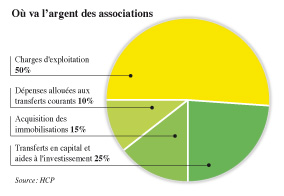
En 2007, les ONG ont dépensé 5,9 milliards de dirhams. Ce qui correspond à 66% de leurs ressources


Elles sont jeunes, concentrées dans les régions de Rabat-Salé- Zemmour-Zaer et de Souss-Massa-Draâ, à rayonnement local, et elles privilégient les actions de proximité. Le Maroc compte 145 associations pour 1.000 habitants contre 1.749 en France par exemple.
C’est ce qui ressort d’une enquête sur les «institutions sans but lucratif» réalisée par le Haut commissariat au plan et publiée jeudi 22 décembre. Le HCP prend l’année 2007 comme référence dans son travail qui tente de cerner le profil du monde associatif. Celui-ci est confronté à de nombreuses contraintes dont le manque d’équipement, une gestion peu professionnelle ou encore l'indisponibilité des bénévoles.
L’enquête relève ainsi que 80% des associations ont été créées entre 1997 et 2007 et 4 sur 10 depuis le lancement de l’Initiative nationale de développement humain (INDH). Ce dispositif mis en place en 2005 préconise une meilleure coordination entre les interventions sectorielles tout en intégrant les initiatives sociales locales. Les associations ont été donc encouragées et ont servi de relais aux activités et aux micro-projets de proximité avec les populations. Le secteur associatif a attiré plus de 15 millions d’adhérents dont un tiers des femmes. Mais le plus gros des adhésions (57,3%) est concentré sur une poignée d’ONG, les 6,8% les plus importantes. En revanche, plus de la moitié d’entre elles compte moins d’une centaine de membres.
L’enquête du HCP permet aussi de lever le voile sur les ressources financières et les dépenses des associations (voir info). En 2007, elles avaient mobilisé 8,8 milliards de dirhams. Un montant qui reste faible compte tenu de la taille du tissu associatif, soit près de 45.000 structures. Les chiffres relevés sont assez éloquents: une association sur cinq fonctionne avec un budget annuel de moins de 5.000 DH, une sur trois avec moins de 10.000 DH et seules 5,4% disposent d'un budget de plus de 500.000 DH. Celles dont le budget dépasse un million de dirhams représentent 2,5%.
Côté financement, la plupart vivent de cotisations d’adhérents surtout pour les plus petites (celles dont le budget n’excède pas 10.000 dirhams). En revanche, les contributions des membres ne représentent que 4,3% des ressources des structures qui disposent de budgets au-dessus de 10 millions de dirhams. Ce sont aussi celles qui ont la capacité de lever des fonds grâce à la qualité de leur réseautage. A côté de cette rareté «des ressources», les associations méconnaissent les règles de gestion puisque 94,7% d’entre elles ne tiennent pas de comptabilité.
Ces structures, dont l’offre de service n’est pas exclusive aux adhérents, souffrent aussi d’insuffisances d’équipements essentiels. Elles sont faiblement équipées en matériel informatique et 7% seulement sont connectées à internet. «Moins d'une association sur cinq dispose d'un ordinateur et même lorsqu'elles en disposent, leur nombre ne dépasse pas deux dans plus de 72% des cas», note l’enquête. Le taux d'équipement varie en fonction du domaine d’activité: de 11,4% pour les associations œuvrant dans l'«environnement» à 34,3% pour celles opérant dans: «droit, défense des citoyens et des consommateurs et politique». Mais même si elles exercent dans des conditions difficiles, les associations sont peu attirées par l’opportunité qu’offre la mutualisation des moyens: plus de huit sur dix ne sont affiliées à aucun réseau et 87,7% d’entre elles agissent seules sans recourir au partenariat. Seules 7,9% des associations ont établi des partenariats avec l’Etat ou des établissements publics et 2,7% avec les collectivités locales. Les partenariats avec l’étranger sont noués par 1,5% des associations.
Par rapport aux ressources humaines, les associations sont également confrontées au manque de bénévoles. En tout cas, plus de la moitié d’entre elles trouve des difficultés à les mobiliser ou à convaincre ceux déjà engagés de rester. Et ce, sachant que 7 associations sur 10 en dépendent totalement. «En 2007, le secteur associatif a mobilisé près de 352.000 bénévoles pour 96 millions d'heures de travail, soit l'équivalent de 56.524 emplois à temps plein», note le HCP.
Le secteur associatif mobilisé 33.846 emplois rémunérés en équivalent temps plein et si on tient compte de l’emploi bénévole, sa part dans l'emploi global au Maroc est de 0,9% en 2007.
Khadija MASMOUDI @ L'economiste

6 microfinance crises that the sector does not want to remember


microfinance crisis
Microfinance Focus, April 22, 2011: Microfinance sector has served as a boon for the rural community providing them financial support to uplift their position in the society. In the process of changing the lives of several thousands of people, the sector has suffered several hardships over the years and faced some severe hurdles. Here is an account of some most important crisis which shaken the microfinance sector.
1) Nicaragua Microfinance crisis of 2008:
In the mid 2008, a movement called “Movimiento No Pago” started which initialized the organization of violent protests and ultimately forced the microfinance institution branches to close. The movement has been mostly by farmers who have ties with the left-wing party. The leaders of the Movimiento No Pago from the North and Caribbean regions of Nicaragua have issued warnings that they will lead to mass destruction which includes burning the buildings of MFIs, taking hostage of MFI personnel and increasing the threshold of violence in case their demands for the moratorium law is not met.
What caused the crisis?
The microfinance industry in Nicaragua is under siege by a politically motivated group of borrowers who call themselves the No Payment Movement (Moviemiento No Pago).  The group is led by the former mayor of Jalapa, Omar Vílchez. The movement commenced in Jalapa in the summer of 2008, with the takeover of an MFI and a riot provoked by a protest speech. Recently, the leaders of the movement have demanded that the Congress approve a Moratorium Law to give debtors a 10 year amortization period with interest rates that do not exceed 8 percent APR in order to put a stop to the harassment faced by the micro-finance industry.
Impact on mf sector and concerns:
The Nicaraguan microfinance industry suffered a profound crisis in 2009 and 2010 as a result of both the international financial downturn and the domestic No Pago (No Payment) Movement. Heightened by political interference, these events took a toll on Nicaraguan MFIs and left them both illiquid and unpopular.  As reported by La Prensa, more than 100,000 clients have stopped receiving credit. The industry served some 324,000 clients before the crisis, while today it serves an estimated 225,000. Total portfolio dropped from US$420 million in 2008 to US$170 million at present. Despite heavy write-offs, members of the Nicaraguan microfinance institution association (known by its Spanish acronym, ASOMIF) have an estimated portfolio at risk of 19 percent.
2) Kolar Microfinance crisis of 2009:
In 2009 in Kolar, Karnataka ( India) 60-70% of its microfinance clients were Muslims. Most of the practices of microfinance institutes (MFIs) such as having women meet with unrelated men and taking clients out of town for training were considered to be against their religious traditions. The issue grew bigger and bigger and one day it reached a tipping point when the local Anjuman Committee issued a ‘fatwa’ against MFIs operating in the area for the demanding the removal of such customs. Communication between the clients and the MFIs to come to a standstill and also affected the process of loan repayments. This led to a lot of disturbance in the MF sector in Kolar and eventually the adjoining areas.
What caused the crisis?
MFIs promptly blamed the whole issue on religion whereas religion played only a peripheral role in what caused the crisis. The main causes of the crisis in Kolar are believed to be the following:
·Multiple borrowings by clients and in some cases use of phantom customers by fraudsters in order to increase borrowings
Other issues such as gender equations in families, down turn of silk industry, vested business interest and communal organization, also played a major role.

Impact on the microfinance sector and concerns:
From Kolar, the crisis gave way to similar situations in other parts of the state. Due to the hold of local religious leaders (and their youth committees) over their community, the fire of delinquency spread fast. It was provoked by the overheated lending environment created by competition amongst the many registered MFIs and an unknown number of unregistered lenders. In some slums in Bangalore, the “Kolar trouble” was used almost merrily by local leaders to provoke similar crisis in other critical areas. The crisis in silk industry in Sidlaghatta, the silk industry crisis in Ramanagaram, the religion masks business rivalry, and communal riots, economic distress and delinquency in Mysore were all fuelled by the Kolar crisis.
3) Andhra Pradesh Microfinance crisis of 2010:
The microfinance crisis in the southern Indian state of Andhra Pradesh was triggered by astounding number of suicides among over-indebted clients of some of India’s biggest microfinance institutions (MFIs). The suicides brought on by explosive growth of microfinance organizations in Andhra Pradesh, led to rising debt stress among thousands of other clients. In the hunger to meet their growth targets, loan officers sold loans to clients already indebted to other organizations. To take charge of the situation, the state Government passed a restrictive ordinance severely curtailing the activities of the MFIs. The crisis threatened microfinance sector not only in Andhra Pradesh, but nationwide.
The above mentioned cases tensed the already critical situation in AP. The microfinance crisis in the state was attributed to usurious interest rates charged by the MFIs, stringent recovery measures of MFIs, limitations of on-lending, continued misery of the rural population, competitive politics that made sustainable interest rates unsustainable and State-civil society conflicts.

Impact on the microfinance sector and concerns:
In October 2010, keeping in view a series of suicides of borrowers of microcredit (over 53 suicides in less than 8 months), the state government of Andhra Pradesh passed an Ordinance to regulate working of microfinance institutions. The ordinance was passed to stop alleged abusive practices like higher interest rates and unlawful collection mechanism undertaken by a few microfinance institutions.
What caused the crisis?
With more than 40 MFIs clustered in the state, an unprecedented level of competition has made multiple borrowing a commonplace phenomenon.
In the year 2006, Andhra Pradesh was faced with a similar problem – The Krishna Crisis. In the Krishna district, multiple borrowing combined with repayment difficulties, coercive recovery practices of MFIs and clashes with the state-run Velugu SHG programme led to a government clamp down on the MFIs, which sparked a repayment crisis and large scale defaults by MFI clients.
Further, the unabating number chase by microfinance institutions has given quite a stressful job to their loan officers. The average loan portfolio per credit or loan officer has reached to Rs 20 lakhs and can even escalate up to Rs. 50 lakhs for larger MFIs. A loan officer on average serves 380 borrowers and this number goes up to 500 in the larger MFIs. To achieve these unrealistic targets loan officers resort to coercive lending and recovery methods.
According to a report prepared by the Gender Unit of SERP which listed 54 microfinance related suicide cases in Andhra Pradesh, unbearable harassments by loan officers of some of the largest MFIs were reported to have driven poor borrowers to death. The report has even alleged that MFIs abetted borrowers to commit suicides. Moreover, out of the 123 cases of harassments which the report lists, there were 47 cases of multiple borrowings, with borrowers being chased by many MFIs for loan recovery.
Impact on the microfinance sector and concerns:
As per the ordinance, no MFI was allowed to carry out its operations until they registered with the government. Thus, all existing operations were halted. Borrowers began to lose their discipline and even took advantage of the situation by refusing to repay the loan. Many were also instigated by local politicians to refuse repayments. With this becoming a phenomenon across the state, default rates soared for the first time ever. The obvious result of it was a reduction in cash flow and fresh capital from financial institutions drying up. There was a lot of chaos in the MF sector and regulation went for a toss.
While many microfinance institutions have suffered losses and still continue to face uncertainty, the real people who will be impacted are none other than the borrowers. There is a real danger that, borrowers, especially in Andhra Pradesh may face a hard time in getting access to credit for years to come.

4) The 2010 Pakistan floods:
The 2010 Pakistan floods began in late July 2010, , resulting from heavy monsoon rains in the Khyber, Pakhtunkhwa, Sindh , Punjab and Balochistan regions of Pakistan and affected the Indus River basin. Approximately one-fifth of Pakistan's total land area was underwater. In a country that already battled poverty, people had lost everything: homes, crops, and livestock – any hope of a livelihood. The poverty stricken rural sector was unable to repay the existing loans and due to future uncertainty of repayments people were not in a position to borrow more from the MFIs. As a result, the microfinance sector suffered great losses and is still reviving with the help of different international agencies.
What caused the crisis?
At their peak, the Pakistan floods last summer submerged almost one-fifth of the country’s total land mass destroying 21% of the crop areas, killing or injuring thousands, destroying homes, businesses, schools, and health facilities, and bringing widespread outbreaks of disease. Women across the board, whether they were contributing to share farming, family owned crops or caring for livestock, had no means of survival. Women who used other skills like sewing and crafts to generate some income had also lost their tools, raw materials, work‐spaces and clients. Basically, the borrowers, most of them being women, lost all means of repayment of their existing loans as they lost their means of livelihood. At the time when they needed the micro-credits from the MFIs, the institutions were in no position to lend more as the previous debts had not been cleared. This led to severe microfinance crisis in Pakistan.
Impact on the microfinance sector and concerns
The wide-scale damage to infrastructure, and particularly to agriculture, dealt a massive blow to the already struggling economy.  The flood cost microfinance institutions over $125 million in losses. MFI’s branches had been destroyed, livestock of clients had drowned, and small-scale industries funded by MFIs had been damaged. Preliminary estimates suggested losses of nearly PKR 2.0 billion out of a total portfolio of PKR 7.1 billion in the flood-affected districts. Additionally, 86 branches belonging to microfinance providers had been damaged.
There is a fear that the government may leave microfinance institutions from any settlement deal, as they are not regulated by the central bank. If the government leaves them out then the ultimate effect will be on the balance sheet of commercial banks since MFIs borrow from commercial banks to extend small loans to poor client.

5) Liquidity crisis in Nigeria:
Nigerian microfinance sector has been confronted with several challenges since the launch of the Microfinance Policy Framework in 2005. A large proportion of the current situation must be attributed to the Central Bank of Nigeria (CBN) that awarded hundreds of licenses to banks in attempts to create a large mf sector. Most of these microfinance banks (MFBs) were deficient in their understanding of the microfinance concept and the methodology for delivery of microfinance services to the target groups. Many of them lost focus and began to compete with deposit money banks for customers and deposits, leaving their target market unattended, in spite of efforts of the regulatory authorities to put them back on track. As a result what was created was chaos which led to the liquidity crisis in Nigeria.

What caused the crisis?
The major factors that contributed to the unsoundness of the MFBs were attributed to high level of non-performing loan resulting in high portfolio at risk which had impaired the capital, gross under-capitalization in relation to level of operations, poor corporate governance and incompetent boards.
Other reasons such as high level of non- performing insider-related credits and other forms of insider abuse, heavy investments in the capital market with the resultant diminution in the value of investments, poor asset-liability management owing to mismatch, heavy investments in fixed assets beyond the maximum limit prescribed also contributed to the situation.
Impact on the microfinance sector and concerns:
The impact of the global financial crisis on MFBs had been more severe than anticipated. Credit lines dried up, competition became more intense and credit risk increased, as many customers of MFBs were unable to pay back their credit facilities owing to the hostile economic environment. Some major steps taken were:
The operating licenses of the 224 out of 820 MFBs that were found to be ‘Terminally Distressed’ and ‘Technically Insolvent’ had been revoked by the CBN. NDIC in line with its statutory responsibility was required to pay up maximum insurance coverage of N100,000 per depositor.
The bank directors and management of the closed banks that have abused their positions were handed over to the Law Enforcement Agencies for investigation and prosecution, and those found culpable were blacklisted.
The liquidity crisis severely weakened the microfinance sector and its ability to achieve the policy objective of economic empowerment at the lower end of the market.

6) Bosnia and Herzegovina (Bih) Microfinance crisis of 2009:
BiH microfinance sector experienced rapid growth from 2006 to 2008, but suffered a downfall in 2009 as a result of high indebtedness among clients and the adverse effects of the global financial crisis. The 13 members of the Association of Microfinance Institutions (AMFI), which account for the bulk of the sector, reported a fall in gross loans to EUR0.5bn at end‐Q309 from EUR0.6bn at end‐2008. The banking sector consisted of 30 banks 2 (21 of which were foreign owned) and reported gross loans of EUR7.4bn at end‐H109. Both the MFI and the bank sectors had registered strong growth in their loan books in the years leading up to Q408 (2007 growth of 85% and 28%, respectively), when the financial crisis hit the country.
What caused the crisis?
MFI growth had been financed by relatively cheap cross‐border funding from microfinance investment funds (MIVs), as well as by funding from local commercial banks. Banks, the majority of which are foreign‐owned, benefited from funding support from their parents. The availability of funding led to high levels of competition, to which MFIs responded by loosening their underwriting standards (eg
increasing maximum loan amounts and widening loan purposes) and introducing new products (eg consumer loans). In the absence of a centralised credit bureau until 2008, this led to relatively high levels of cross‐ and over‐indebtedness among MFI borrowers.
Impact on micro-finance sector and concerns:
With the onset of the financial and economic crisis, these borrowers started experiencing repayment pressures, as remittances fell, unemployment rose and business turnover fell. Loans in arrears increased sharply: by end‐Q309, AMFI members were reporting loans in arrears more than 30 days of 6%, which came as a shock for a sector used to reporting arrears rates of less than 1%.
In parallel, funding became less available and more expensive for MFIs, and they were forced to adjust to a stagnant/low growth scenario, put increased attention on arrears management, and in many cases put on hold plans for transformation to deposit taking structures.
There have been controversies, scandals and accusations over all these issues but the field has revived itself ad midst all these difficulties and still is working to re-organise the sector to ensure the faith of hundreds of people across the globe.

vendredi 23 décembre 2011

Société civile : 44 771 associations actives au Maroc

Le Maroc comptait 44 771 associations en 2007, soit 145 associations pour 100 000 habitants, selon une enquête du Haut-Commissariat au Plan (HCP). A titre de comparaison, ce taux est de 1 749 en France (en 2005) et de 508 au Canada (en 2003), précise le HCP qui vient de révéler les principaux résultats de son Enquête nationale auprès des institutions sans but lucratif (ISBL) lancée en 2009. La majorité de ces associations sont des structures jeunes et sont présentes sur tout le territoire national avec une relative concentration au niveau des régions de Rabat-Salé-Zemmour-Zaer et de Souss-Massa-Drâa.

jeudi 22 décembre 2011

Une commission révise la loi bancaire afin d'intégrer les financements alternatifs


Selon les chiffres avancés par Bank al MaghrIb (BAM), les transactions relevant de la finance islamique  ont réalisé 800 millions de dirhams au troisième trimestre de l’année en cours, soit une baisse significative de 100 millions de dirhams par rapport à la même période en 2010.  Selon les sources d’un responsable de BAM, il semblerait que la réunion à huis-clos d’un comité mixte BAM- GPBM (Groupement professionnel des banques du Maroc) avait pour but de revoir l’actuelle loi bancaire dans le sens de l'intégration de financements alternatifs dans le système bancaire marocain. 
D’après cette même source, le comité s'est inspiré d'un ensemble d’expériences internationales, en considérant l’expérience indonésienne qui a créé une diversité de modes de financement économique  avec l'harmonisation et les modes de financement classiques et islamiques, et leur complémentarité. Le Maroc devrait donc prendre exemple sur ces expériences pour  diversifier ces modes de financement. 
D’ici le début de l’année prochaine, il se peut que BAM procède au lancement de deux nouveaux modes de financements alternatifs appelés "Salam" et "al Istisna3",  principalement réservés aux professionnels.
En effet, BAM a souligné dans son rapport le faible niveau enregistré par la finance islamique dans le marché financier marocain. Cela est dû, d'une part, au manque d’interaction d’un bon nombre d’institutions bancaires avec les directives islamiques, et d'autre part, à la réticence de nos banques nationales  à créer une institution spécialisée dans le financement alternatif, à l’instar de la banque "Assafaa" qui a vu le jour en juin 2010. 
Selon ce même rapport, BAM a annoncé que le volume du marché de la finance islamique mondiale doublera  en 2015, avec un montant prévu de 2800 milliards de dollars.
D’après Omar el Kettani , un expert en finance islamique , le retard du marché marocain concernant ce type de financement est essentiellement dû a l’absence de volonté politique des anciens gouvernements qui ne faisaient que contrecarrer ce type d’investissements, retardant d'autant le décollage économique du pays.
De son côté, Abdeslam Bellaji, président de l’Association marocaine d’études et de recherches en économie islamique (AMEREI), affirme que le montant de 800 millions de dirhams est faible, et qu’il démontre le retard que "connaît le Maroc dans l’intégration du financement islamique dans son système financier".
 Il a également démontré que "la lenteur d'évolution du marché des finances alternatives" revient aussi à la cherté de ce genre de financement, en comparaison avec les modes bancaires classiques, ajoutant que la stagnation du marché de l’immobilier durant l’année 2011 est aussi en cause, car il est l’un des secteurs les plus concernés par les financements islamiques.
Bellaji a insisté sur le renforcement du financement islamique "comme priorité d’un Etat et d’un peuple", en considérant que c’est l’une des meilleures solutions "pour attirer les capitaux du golfe, convoités par ailleurs par un bon nombre de marchés internationaux".  Pour cet expert, "tout autre retard dans ce contexte accroîtra la crise de financement dans l’économie du pays et privera les Marocains de l’harmonisation existante entre leurs croyances islamiques et la réalité socio-économique qui est la leur".
Pour sa part, Lahcen Daoudi, professeur d’économie et député  PJD, a assuré que la précédente proposition de loi du PJD concernant les banques islamiques et les grandes institutions financières prévoit de combler le vide législatif dans ce domaine.  Toutefois, il a ajouté qu’il n’était pas sain que le Maroc soit surclassé dans ce domaine par d’autres pays. Il a estimé que le Maroc reste en retard et se prive de sa part d'un marché, d'un pactole,  mondial évalué à un montant de 1000 milliards de dollars. Daoudi a appelé les institutions financières à adopter ce type de financements, qui n'a rien d'idéologique, mais porte à satisfaire des franges de la population qui sont parfaitement en droit d'avoir accès à un mode de financement adapté à leurs besoins et leurs croyances.
C'est dans cet ordre d'idées que Bellaji prévoit, dans un premier temps, l’ajustement de l’actuelle loi bancaire dans un sens ou elle permettrait l’intégration des modes de financements alternatifs islamiques dans les offres de financement, en attendant l’adoption d’un texte juridique complémentaire aux lois bancaires actuelles, qui ne comblent plus les besoins du marché économique ni les attentes de la société marocaine.

Attajdid

mardi 20 décembre 2011

Symbiotics NewsWatch #190, 20 December 2011


Dec. 20India: Microfinance Lenders Can Now Borrow Up To $10M From Abroad
The Indian central bank has eased the norms for local microfinance institutions (MFIs) – so that these may raise funds through overseas borrowings. On the face of it, the move is positive for the MFI sector which is, otherwise, beset with regulatory issues and a largely ambivalent domestic fundraising environment. But the quantum of money that an MFI can scoop up outside India is too paltry to make much of a difference for the large players.
Source: VCCircle
 
Dec. 16Kyrgyzstan: European Bank for Reconstruction and Development Arranges the First Syndicated Loan in the Kyrgyz Republic in Local Currency
The EBRD is continuing its efforts to develop local currency lending and local currency capital markets by arranging the first ever syndicated loan in the Kyrgyz Republic, which is also the first syndicated loan in the local currency (som).
Source: EBRD
 
Dec. 16UK Launches Pro-Poor Private Investment Programme in India with Small Industries Development Bank of India 
The UK has launched private sector development programme in India with a commitment of 65 million pound (Rs 520 crore) in partnership with the Small Industries Development Bank of India (SIDBI). 'Samridhi' aims to help the poor in low income states get access to financial services to improve their income and quality of life as well as by promoting responsible and sustainable private sector investment, British International Development Minister Andrew Mitchell said here.
Source: The Economic Times
 
Dec. 15Two additional Microfinance Investment Vehicles obtain LuxFLAG Microfinance Label
LuxFLAG is pleased to announce that two new microfinance investment vehicles have been granted the LuxFLAG Microfinance Label. These are the Azure Global Microfinance Fund SICAV-SIF and responsAbility SICAV (Lux) Financial Inclusion Fund.
Source: LuxFLAG Press Release
 
Dec. 15Zimbabwe: Wholesale Funding Scheme Launched
CBZ Bank and the Zimbabwe Microfinance Wholesale Trust have launched a wholesale funding scheme to financial service providers for on lending to small-scale enterprises. The funding scheme is expected to give impetus to the small and medium enterprises to recapitalise their operations.
Source: AllAfrica.com
 
Dec. 14Microfinance: Industry Urged to Refocus On Poverty
Sharia-compliant retail products now come in every shape and size. From mortgages to insurance and even the Islamic credit card, the choice and availability for Muslims seeking religiously compliant finance has never been greater. But one sector that has continued to lag behind is microfinance.
Source: The Financial Times

lundi 19 décembre 2011

Mohamed Ben Othman, DG de la BIM: «La demande de finance islamique progresse à pas de géants»


naugurée il y a un mois à peine, la banque islamique de Mauritanie (BIM) est la nouvelle venue dans le carré de la finance islamique dans le paysage bancaire et financier national. Son directeur, Mohamed Ben Othman reste optimiste quant à l'avenir de cette finance, et la perçoit, techniquement et éthiquement, comme une véritable voie à explorer pour sortir du cycle de la crise financière qui perdure depuis quelques années. Entretien.


Mohamed Ben Othman, DG de la BIM: «La demande de finance islamique progresse à pas de géants»
La demande financière islamique est-elle de plus en plus importante en Mauritanie? 
Je le pense. Il n’y a pas de statistiques sur le sujet, mais j’imagine que la Mauritanie ne fait pas l’exception dans ce domaine. La demande de finance islamique progresse à pas de géants. D’ailleurs aujourd’hui même les banques conventionnelles soucieuses de servir leurs clientèles et d’enrichir leur gamme de produits, se mettent à offrir des produits islamiques. Ceci illustre bien une croissance de la demande mais aussi l’importance de cette niche de clientèle pour les banques. 

Certains financiers pointent du doigt la cherté des produits financiers islamiques par rapport à ceux issus de la finance «conventionnelle». Est-ce un un constat juste? 
Commercialement ça ne tient pas. Si on regarde les résultats enregistrés par les banques islamiques, on constate que la progression de leur chiffre d'affaire, est une progression à deux chiffres, largement plus importante que pour les banques conventionnelles. 

Pour qu'il y ait un tel succès commercial, il faut que les produits proposés, spécifiques il est vrai, soient viables, par rapport aux autres produits proposés. Viables veut dire qu’ils correspondent à des besoins latents de la clientèle, mais aussi proposés à des conditions et des prix compétitifs. Car la clientèle des banques islamiques aujourd'hui, n'est pas forcément et exclusivement musulmane. Elles doivent pouvoir attirer des clients qui ne soient pas particulièrement sensibles à la religion; et j’imagine que si elles ont pu le faire ,c’est certainement avec des prix moins élevés. Donc cet argument ne tient pas.


Mohamed Ben Othman, DG de la BIM: «La demande de finance islamique progresse à pas de géants»
Vous venez d'arriver en Mauritanie. Quelles sont vos ambitions? 
Elles sont mesurées, avec nos moyens financiers et humains. Nous proposons aux mauritaniens un produit islamique pur. Filiale du Groupe Tamweel Holding Africa, qui est détenue à 60% par la Société Islamique pour le développement du secteur privé (filiale à 100% de la BID), et à 40% par Bank Asya première banque islamique en Turquie. 
L'origine des fonds est une origine déjà islamique. On a investi également dans un système informatique exclusivement islamique (système certifié par l’organisation de l’audit et de Comptabilité des institutions financières islamiques connue sous le nom de AAOIFI). Ce système ne peut appréhender que les opérations islamiques. En d'autres termes, si je veux faire passer une opération conventionnelle, non islamique dans le système, ce dernier ne peut pas l'appréhender. 

Comme toutes les banques, pour que nous puissions évoluer, il faut que notre offre corresponde aux attentes de nos clients. Nous savons qu’il y a de véritables attentes en matière de produits islamiques; aussi nous veillerons à ce que notre offre puisse répondre à toutes ces attentes en matière de prix et de qualité de service. Quant à notre positionnement nous sommes une banque conventionnelle, et à ce titre on va s’intéresser aux deux segments important de l’économie mauritanienne: les Entreprises et les Particuliers, avec une offre islamique spécifique à chaque segment. 

Dans le contexte international de crise financière persistante, la finance islamique peut-elle être perçue comme une voie de sortie crédible? 
Bien sûr. C'est pour cela que je disais que les banques internationales, prenant la juste mesure de la finance islamique, commencent à sérieusement proposer des produits islamiques. Ce ne sont pas des banques appartenant à des actionnaires musulmans. Les plus grandes banques occidentales s'y mettent, parce qu'elles ont constaté que cette approche est peut-être l'antidote de cette crise, qui résulte d'un saut périlleux dans une finance virtuelle. 

Rappelez-vous que lorsqu'on a essayé d'analyser la crise, notamment de comprendre les fondements de ces produits toxiques, élaborés avec des modèles mathématiques extrêmement complexes, personne au final, n'a pu étayer les bases concrètes, matérielles, sur lesquelles ces modèles ont été construits. 

La finance islamique ne crée pas la monnaie; à ce titre elle n’est pas inflationniste. C'est une finance qui a plus tendance à augmenter la production, car il y a toujours ce sous-jacent tangible et économique. On n'est pas dans une logique de spéculation, de loterie financière, avec des produits toxiques, qui donnaient des revenus bien supérieurs aux produits classiques bancaires, mais dont les dérives ont causé sans nul doute la plus grande crise financière de l’histoire de la finance. 

Du côté de la finance islamique, les choses se passent différemment puisqu’il y a toujours un sous-jacent tangible sur lequel est adossé le financement. Si vous voulez acheter une voiture, je ne vous prête pas l'argent, mais je vais l’acheter et vous la vendre. C'est le principe de la Mourabaha.

Mohamed Ben Othman, DG de la BIM: «La demande de finance islamique progresse à pas de géants»
On met souvent en avant des montages financiers islamiques parfois tout aussi compliqués, sinon qui nécessiteraient plus de compétences techniques, par rapport au lien nécessaire entre l’éthique musulmane et un rendement commercial et financier... 
Je ne pense pas que cet avis est correct. La finance islamique n’a pas la réputation d’être élaborée sur des montages complexes. C’est plutôt le contraire, car elle est basée sur des principes de la Charia qui, eux sont simples, pour être compris par tout le monde. 

Maintenant je peux comprendre la difficulté de certains de comprendre ces principes. Cette difficulté, selon moi, est née soit de la méconnaissance de l’islam et de ses principes généraux, soit de la déformation culturelle des gens comme nous qui ont grandi avec les banques conventionnelles ne proposant que des produits basés sur le crédit, les intérêts… 

J'ai donc plus tendance à dire que la finance islamique est moins complexe que la conventionnelle; et c’est peut-être là, une des explications de son succès. Les opérations dans la finance islamique sont normalement adossées soit à une location (la Ijara…) soit à une vente avec marge (la Mourabaha) soit à une participation en capital (Moucharaka et Moudharaba). Je ne vois pas où est la complexité dans tout cela. 

Depuis votre récente ouverture, les biens matériels auxquels sont adossées vos premières opérations de financement sont de quelles natures? 
Un certains nombre de dossiers sont à l’étude. On essaye de faire notre évaluation du risque correctement. On ira ensuite crescendo avec une approche prudente. On va monter en volume de financement en fonction des projets bancables qu'on verra. 

Plusieurs paramètres sont à considérer pour nous ajuster au marché mauritanien. Nous avons la prétention d'être une banque active. On n'est pas venu pour ouvrir des comptes simplement, ça ne peut pas être l'objet d'une banque islamique. On étudiera avec le même intérêt des financements à court, moyen et peut-être à long terme. Une banque islamique a plus cette nécessité qu'une banque conventionnelle, d'avoir un portefeuille à moyen et long terme. En attendant de développer un marché de Sukuk Islamiques en Mauritanie qui permettra une gestion dynamique de l’excédent de trésorerie à l’instar de ce qui existe aujourd’hui avec les banques conventionnelles avec des produits de marché monétaire. 

Appréhendez-vous la bancarisation très faible en Mauritanie? 
La Mauritanie est un pays dans lequel une banque islamique a toutes les chances de réussir, compte tenu du degré d'islamisation du pays, mais également du taux des pratiquants. Le contexte est donc favorable au développement d’une finance islamique. D’ailleurs, nous commençons à le percevoir au travers de nos contacts avec nos clients et prospects. Pour beaucoup d’entre eux la banque Islamique de Mauritanie est leur première banque dans laquelle ils ont ouvert de compte. Ce qui est un paradoxe et étonnant, quand on considère les moyens de ces personnes. 

Donc par rapport à l’appréhension du faible taux de bancarisation, et par rapport à notre apport à améliorer ce taux, nous sommes convaincus que nous allons jouer un rôle qu’on espère important, car nous constatons que nous sommes entrain d’ouvrir des comptes pour des gens non bancarisés. Forcément, si ce trend se confirme, cela impactera sans doute le taux de bancarisation, qui faut-il le rappeler est un des fondamentaux d’une économie. 

Propos recueillis par Mamoudou Lamine Kane
Noor Info

jeudi 15 décembre 2011

Finance islamique : L’investiture du PJD, une opportunité ?

 Bientôt, une banque islamique au Maroc ? En tout cas, il n’aura pas fallu attendre longtemps après la nomination du PJDiste Abdelilah Benkirane en tant que chef du gouvernement pour que les spécialistes de la finance islamique fassent des propositions concrètes. Les qataris de QIIB, l’un des leaders de ce domaine, ont en effet rencontré le chef du gouvernement, samedi dernier, dans une entrevue qui a pris l’air de l’officialisation de l’intérêt porté par l’institution pour une implantation dans le royaume. Selon le top management de QIIB, « la rencontre aura permis aux deux parties de discuter des perspectives de création d’une banque islamique au Maroc ainsi qu’une entreprise d’assurance du même genre ». Un modèle de cette implantation a même été proposé à la partie marocaine selon lequel QIIB prendrait pied dans le royaume via une joint- venture dont elle détiendrait 49%. Cette proposition n’a, semble-t-il, pas laissé indifférent Abdelillah Benkirane qui a déclaré, en marge de cette rencontre que « le Maroc est désireux de faire appel à l’expertise de QIIB dans la finance islamique. Une collaboration permettrait de stimuler le système bancaire marocain et pourrait répondre aux besoins des consommateurs ». En d’autres termes, les portes sont ouvertes à une pareille opération. Interpellé par Les Échos quotidien sur le sujet, Lahcen Daoudi, membre du PJD, va même au-delà en annonçant que « cela pourrait concerner deux voir plusieurs opérations ».
L’opportunité pour le Maroc, selon le PJDiste, est de pouvoir attirer davantage d’investisseurs du Golfe. Ce n’est plus un secret pour personne que la finance islamique est très prisée par cette catégorie d’investisseurs et une implantation d’une banque islamique dans le royaume serait un moyen de leur octroyer un environnement des affaires attractif. C’est dire toute l’importance de l’annonce de QIIB. Celle-ci coïncide par ailleurs, avec l’annonce de la principale banque publique du royaume, BCP, de l’arrêt de la commercialisation de ses «produits halal» en attendant leur restructuration afin de proposer de nouvelles solutions en 2012. Selon une déclaration de son directeur général adjoint aux médias, la banque étudierait même la possibilité de recourir, à l’instar d’Attijariwafa bank, à une filialisation de cette activité. Et c’est ce modèle là qui réussit dans le monde de la finance islamique. D’ailleurs, un texte de loi a déjà été déposé par le PJD en janvier 2011 et s’inscrit parfaitement dans cette logique. Le texte traite à la fois des conditions de création de filiales ainsi que de banques spécialisées dans la finance islamique. De quoi conforter BCP et les qataris de QIIB dans leurs ambitions pour ce secteur. Cette loi, une fois adoptée, répondrait également à la problématique relevée par la Banque africaine de développement (BAD). Selon cette dernière, «la législation bancaire du Maroc n’autorise pas le type d’activité d’investissement direct auxquelles s’adonnent de nombreuses banques islamiques».  Par ailleurs, force est de souligner que pour les banquiers du secteur classique marocain, les services bancaires islamiques sont considérés de plus en plus comme une proposition commerciale et non une considération politique. C’est du moins l’avis des experts de la Banque africaine de développement lesquels viennent de mettre en exergue le degré d’implication des pays de l’Afrique du nord dans ce domaine. Pour le cas du Maroc, une entrave majeure est toutefois relevée pour le développement de ce segment et qui a trait directement au coût des opérations. En effet, la BAD ne manque pas de soulever le problème de la cherté des produits islamiques en comparaison avec les produits bancaires classiques. Les prix ne sont guère attractifs, du fait de l’imposition de 20 % au titre de la taxe sur la valeur ajoutée (TVA) sur Ijara et de 10% sur Mourabaha, tandis que les prêts commerciaux sont exonérés de TVA (seuls les intérêts sont dans ce cas soumis à la TVA). « De l’avis des autorités, étant donné que Mourabaha nécessite un achat et une vente, il devrait être soumis à la taxe. Ijara nécessite également l’achat et le paiement ultérieur de loyers », rapporte la BAD. En d’autres termes, l’occasion est donnée aujourd’hui au PJD, tant qu’il est au pouvoir, de s’atteler à éliminer cet handicap, d’autant plus que, selon les dernières déclarations officielles, il tient à prendre en charge le ministère des Finances. En attendant, il faut dire que le Maroc a déjà tiré profit de la finance islamique via ses différents partenariats avec la Banque islamique pour le développement. Le Maroc est en effet le principal bénéficiaire en Afrique du nord du financement de projets et du commerce de la BID, bien qu’il soit un bailleur de fonds relativement modeste de la BID, arrivant loin derrière la Libye, l’Égypte et même l’Algérie. «L’une des raisons de la réussite du Maroc tient à sa capacité à soumettre des demandes de financement cohérentes fondées sur des plans d’affaires de qualité et assorties de projections réalistes de coûts et de recettes» note-t-on auprès de la BAD.

Par Younes A.TANTAOUI @ Les échos

The Arab Spring: Risks and opportunities for microfinance in the MENA region


by Nadine Chehade : Thursday, December 8, 2011

The Arab Spring took everyone by surprise. There was a series of underlying factors, among them being  a young and growing population, improved education levels for men and women, and decreasing fertility rates, all leading to a vast number of people seeking better economic and social opportunities and questioning traditional patriarchal structures. In addition, unemployment, corruption, and increasing inequalities or concentration of economic power in the hands of a few, led to simmering frustration. As access to new technologies (e.g., mobile, Internet) facilitated the organization of a civil movement, massive uprisings started across the MENA region, now referred to as the Arab Spring, in regard to hopes of a brighter future.
For decades MFIs in the region had been tackling issues linked to poverty and economic development. Although Tunisia and Egypt counted hundreds of small unsustainable microfinance programs, all MENA countries boasted top-performing MFIs that reached excellence at various levels. Yet, over the years, governance and risk management remained relatively weaker areas for those same MFIs.¹  The fact that the vast majority operate as NGOs²  indeed made it difficult to create an adequate balance of power, with sufficient involvement and professionalism from all board members. Besides, MFIs have had difficulty attracting and retaining staff with advanced technical skills due to higher compensation offered abroad. The combination of those factors has weakened risk mitigation, which is the boards’ ultimate responsibility, but that should also involve all the hierarchy chain. More specifically, political risk was never envisioned except for chronically unstable countries such as Lebanon or Palestine. In fact, there was a common belief that stable regimes, regardless of their shortcomings, translated into low political risk. After the Arab Spring, all stakeholders should revise their country risk assessments and scrutinize more common risks as well as their management (credit, operational, institutional, liquidity, and solvency risks). From now on, political risk anticipation and readiness to manage crisis will need to be taken into account, along with coordination at industry level, hence the likelihood of a common response in case of need. In the context of this article and of the Arab Spring, “crisis” will refer to a political risk that has materialized (e.g. drastic political changes, outbreak of violent events, massive demonstrations, and war).
A crisis timeline is typically divided into three main phases (before, during, and after). Before the crisis, a single word sums up all risk mitigation techniques, and that is: preparation. Preparation, for an MFI, means building a strong institution (i.e. sustainable, with appropriate policies, good compliance, diversified portfolio, etc.) that has a business plan with several scenarios or stress tests (e.g. devaluation risk). Preparation also includes anticipating a sudden rise of risk levels by putting in place participative and regularly updated contingency plans: a business continuity plan; succession plan for key positions; substitution plan for all staff with a supervisory role; insurance covering cases of war, strife, or civil unrest; and minimum cash reserves covering at least three months of operating costs to cater for sufficient time to leverage new funds. Last but not least, governance-related matters are of utmost importance, such as avoiding political affiliation, having detailed rules to prevent conflicts of interest, and having capable board members who are able to bring in reliable information on the economic and political trends, and who get along well with top managers. While there is no standard or easy way to address it, crisis usually emphasizes institutional weaknesses as people and systems are put under tremendous pressure. Resilient MFIs have proven to be those who enjoyed, prior to the crisis, a good institutional, financial, and social performance.
During the early stages of a crisis, it is particularly important to avoid emotional decisions, such as the typical granting to all clients a grace period. Some businesses might actually excel during political turmoil. For instance, grocery shops usually witness a peak of activity as people tend to buy and stock up on higher quantities of basic food items. It is also crucial to deliver strong support messages and maintain communications, first with staff, then with clients. In turn, this requires reliable and rapidly available information (e.g. staff and client details), as well as robust systems (e.g. flexibility to reschedule loans) and backups (e.g. to overcome Internet or power disruptions). As soon as it is safe to do so, operations should resume, starting by an assessment of the current situation (e.g. answer potential rumors, assess impact on credit risk, operating costs, and savings withdrawal). Instructions regarding disbursements (e.g. stopped or maintained, for whom, etc.) should be clarified, and clients’ situation, regardless of their number, examined on a case by case basis. Maintaining high internal audit standards is also key (e.g. client visits) as temptation for fraud might be high at both client and staff levels. Another factor is the MFI’s capacity to seek support and mobilize donations to assist clients, which comes with the prerequisite of having built solid relations with various funders. As is the case of staff and clients, fast and transparent communication with lenders, donors, or technical partners remains essential, especially if covenants are breached.
As no anticipation can match reality, plans will of course need to be refined and updated after a crisis, with best practices documented (e.g. crisis committee in place with clear responsibilities, safety procedures in place, and staff trained on them, adapted incentive schemes).
Similarly to all changes, the Arab Spring comes with a mix of hopes and fears. After several years of efforts to overcome risks linked to client protection, a new reputation risk lies ahead as high expectations are put into microfinance as a tool to fight unemployment. In Tunisia and Egypt, officials have already shown a renewed interest in the industry. But while microfinance may indeed contribute to fight unemployment, it will need time to reach the estimated 19 million remaining borrowers in the MENA region.³  This figure compares with 60 to 90 million jobs needed by 2020, making microfinance a partial solution. This is especially so as the region counts 40% to 60% of informal businesses, potentially difficult to scale up, and as impact studies show only 10% to 20% of clients actually graduating out of poverty. Moreover, some markets, large or small, have reached saturation in their urban or semi-urban areas. As a result, bridging the gap will require deepening outreach, which remains as much of a challenge as agricultural lending. But if more enabling operating environments are the opportunity of the Arab Spring, let’s bet practitioners will deploy innovative ways to offer financial access to those who need it most.
¹ Between 2006 and 2010, Planet Rating has granted 7 “A” ratings in the regions, all of which scored “b” on either governance or risk management, while among 17 investment-grade ratings, none scored “a” on those two domains.
² Except for Jordan where MFIs are not-for-profit companies.
³ Arab Microfinance Regional Report: An Industry Update, Sanabel, December 2010.
Over the coming few weeks CGAP’s Microfinance Blog, in partnership with Sanabel and the Arabic Microfinance Gateway, is running a special series on the new challenges and opportunities that were created by the Arab Spring. Featuring voices from various countries including practitioners, donors, and regulators, the series will provide a platform to share lessons learned. We look forward to your comments and discussion.